Professional colorists and salon owners deciding what volume developer for grey coverage need more than a generic developer chart. The wrong choice can leave resistant strands translucent, expose unwanted warmth in the natural base, or create hot roots and visible banding. Duomo Pro supports predictable grey coverage through Italian-crafted, ammonia-free color systems formulated for professional use, but consistent results still depend on selecting the correct activator for the hair’s texture, grey percentage, porosity, and service goal.
The Short Answer: What Volume Developer for Grey Coverage and Why Is 20 Volume the Professional Standard?
For the vast majority of permanent grey coverage applications, 20 volume developer is the professional standard. It opens the cuticle enough to allow full pigment penetration and dependable deposit without creating unnecessary lift in the client’s remaining pigmented hair.
Grey hair contains little or no residual melanin to support the final result, so the color formula must supply the depth, tone, and opacity. The developer’s primary job is controlled cuticle access, not aggressive lightening. Twenty volume provides the balance required for full coverage while protecting the integrity of strands that may already be coarse, dry, or structurally vulnerable.
Moving automatically to a stronger developer does not guarantee better coverage. Excessive lift can dilute the visual density of the deposited pigment, expose warmth in the natural base, and produce inconsistent results near the scalp. For standard permanent coverage on moderately resistant grey hair, use 20 volume and improve the formula, saturation, sectioning, or processing time before increasing developer strength.
What Does Developer Volume Actually Do to Grey Hair?
Grey hair behaves differently from pigmented hair because it often combines a compact cuticle, coarse texture, reduced lipid content, and little or no melanin. That combination can make the strand feel resistant even when the surrounding hair processes normally.
Developer volume determines how strongly the oxidative system swells the hair and creates access for artificial pigment. On pigmented hair, that oxidation may also lighten natural melanin. On grey hair, there is little natural pigment to lift, so the most important function is creating enough controlled access for the color molecules to enter the cortex and develop evenly.
This is why more developer strength is not automatically better. Grey coverage depends primarily on pigment deposit and retention. When the developer opens the cuticle more aggressively than necessary, the formula may lift the remaining natural hair while failing to increase opacity on the grey strands. The result can appear warmer, brighter, or less anchored than intended.
A suitable developer volume for grey coverage creates sufficient swelling for penetration while preserving enough structure for the cuticle to settle around the developed color. In most permanent applications, 20 volume delivers that balance. Lower volumes serve deposit-focused services, while stronger activators should be reserved for specific resistant textures or deliberate lifting objectives.
When Is 20 Volume Not Enough for Grey Coverage, and What Should You Use Instead?
Twenty volume remains the starting point, but very coarse hair with a high concentration of grey may require a controlled adjustment. On clients with approximately 70 percent or more grey, especially when the strands are dense, wiry, and consistently resistant despite correct formulation and saturation, 25 volume may provide slightly greater cuticle access.
That adjustment should follow a review of the entire application. Confirm that the formula contains enough natural or base series, the sections are thin, the product load is generous, and the full processing time has been respected. Increasing developer cannot compensate for an under-pigmented formula or incomplete saturation.
Stubborn temple and hairline grey rarely requires stronger developer. Those areas are commonly resistant because the strands are compact, exposed to frequent washing or skincare products, and difficult to saturate thoroughly. The better correction is usually to apply there first, use precise subsections, increase product saturation, allow the full recommended timing, and pre-soften when appropriate. See the professional approach to resistant grey hair for a complete troubleshooting process.
For a deeper look at why certain strands remain difficult to saturate, review how resistant grey hair behaves and which formulation, timing, and application adjustments improve coverage.
Thirty volume is rarely the right solution for routine grey coverage. It can create hot roots, excessive warmth, uneven deposit, and avoidable stress on coarse or compromised grey strands. Use it only when a manufacturer’s specific formula requires it or when intentional lift is part of the service objective.
When Should You Use 10 Volume Developer for Grey Coverage?
Use 10 volume when the service requires deposit or blending rather than complete, opaque coverage on resistant grey hair. Its lower oxidative strength limits lift and helps preserve the tone and condition of previously colored or porous areas.
For clients with a low percentage of grey who prefer a softer transition, 10 volume can support demi-permanent blending. The grey remains intentionally diffused rather than fully concealed, producing a lower-commitment result with a softer line of demarcation as the hair grows.
Ten volume is also appropriate when refreshing faded color through the mid-lengths and ends during a root coverage service. Previously colored lengths are usually more porous than new growth and do not need the same cuticle opening as resistant roots. Using a deposit-focused formula helps prevent unnecessary darkening, dryness, and tonal buildup.
It can also be used as an overlay on previously colored hair when the goal is to restore tone without lifting the underlying base. However, 10 volume is not the correct choice for complete coverage on coarse, resistant grey. It may not open the compact cuticle sufficiently, leaving strands translucent or causing the color to fade prematurely.
What Developer Mistake Causes Hot Roots and Banding on Grey Hair?
Using a developer that is too strong at the root is a common cause of hot roots and banding during grey coverage. Heat from the scalp accelerates oxidation, so a high-volume developer can lift the remaining natural pigment faster at the root than the formula deposits depth into the grey.
This creates a brighter or warmer root area and a visible transition into cooler or darker mid-lengths. The problem becomes more pronounced on clients with mixed porosity, previous color, or a combination of grey and naturally pigmented hair.
The correction is not to rotate through different developer strengths without a clear formulation reason. Use a consistent 20 volume at the new growth, then control the result through application order and timing. Begin in the most resistant areas, apply thin sections with complete saturation, and move to more receptive zones later. Treat previously colored lengths with a separate deposit formula when necessary.
When a client already has uneven warmth or a visible root band, correct the underlying formulation and application issue rather than simply reducing processing time. The professional guide to preventing hot roots explains how scalp heat, developer strength, base selection, and application sequence interact.
Which Developer Volume Should You Use for Each Grey Coverage Scenario?
Use this chart as a practical chair-side reference. Always follow the processing ratio and timing specified for the professional color line being used.
| Scenario | Recommended Developer | Key Reason |
| Standard resistant grey, full coverage | 20 volume | Optimal cuticle access for deposit without excess lift |
| Stubborn temple or hairline grey | 20 volume plus extended timing | Volume is not the fix; timing and saturation are |
| Very coarse, high-density grey of 70% or more | 20–25 volume | Slightly greater oxidation may aid penetration into resistant hair |
| Demi-permanent grey blending | 10 volume | Deposit-focused result with little or no lift |
| Refreshing faded color through the lengths | 10 volume | Helps prevent over-processing on porous ends |
| High-lift color on grey, such as Cavalla | Per brand specification | High-lift chemistry requires a formula-specific activator |
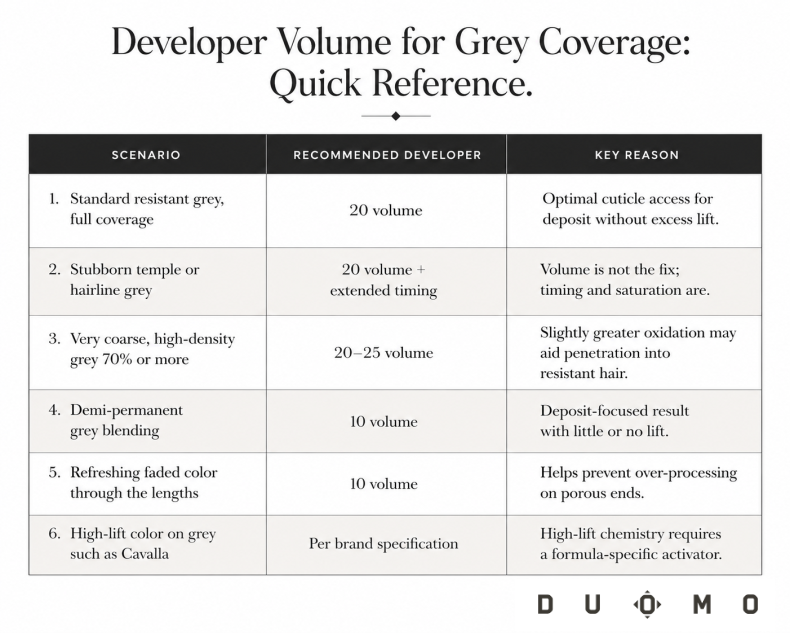
The chart provides a starting framework, not permission to ignore the condition of the hair. Texture, porosity, existing artificial color, target level, base shade, and manufacturer instructions must still guide the final formulation.
How Do Duomo Activators Work With Grey Coverage Formulas?
Duomo activators are calibrated to work with Duomo’s ammonia-free professional color chemistry. That compatibility matters because grey coverage depends on the relationship between the color base and activator, not on developer strength in isolation.
A matched system controls how predictably the formula mixes, oxidizes, accesses the cortex, and develops its intended depth and tone. This improves repeatability for grey coverage clients returning every four to six weeks, where small formulation inconsistencies can become visible across consecutive applications.
Using the designated activator also allows the colorist to follow the prescribed mixing ratio and processing time rather than adapting a formula around a developer with different stabilizers or performance characteristics. Duomo’s full activator range is available through professional salon accounts.
FAQs About Developer Volume for Grey Coverage
Can I use 30 volume to speed up grey coverage?
No. Thirty volume does not simply make grey coverage process faster. It creates more lift and stronger cuticle swelling, which can expose warmth, dilute depth, and increase the risk of hot roots. For resistant grey, improve saturation, base-shade support, application order, and processing time before increasing developer strength.
Does developer volume affect how long grey coverage lasts?
Yes, but stronger developer does not necessarily produce longer-lasting coverage. A developer that opens the cuticle too aggressively can contribute to porosity and faster pigment loss. Lasting coverage comes from using the correct matched activator, sufficient pigment, complete saturation, proper timing, and appropriate aftercare.
Should I use different developer volumes on roots versus ends?
Often, but the difference should reflect the service being performed. Resistant new growth commonly requires permanent color with 20 volume, while previously colored lengths may need a separate deposit formula with 10 volume. Do not pull the stronger root formula through porous ends unless the manufacturer’s directions and the hair’s condition support it.
What happens if I use too low a volume on resistant grey hair?
The cuticle may not open enough for full pigment penetration. Resistant strands can remain sheer, appear lighter than the surrounding hair, or lose color quickly after the service. For complete permanent coverage on coarse grey, 20 volume is generally more reliable than 10 volume.
Is 20 volume safe for ammonia-free grey coverage formulas?
Yes, when the professional color line specifies 20 volume and the formula is used according to its directions. Ammonia-free does not mean developer-free; the color system still requires controlled oxidation to develop pigment and create cuticle access. Use the activator designed for the formula and follow its prescribed ratio and processing time.
For the complete grey coverage system, from consultation and formulation to application and troubleshooting, start with the professional grey coverage formula framework.