For professional colorists and salon owners, choosing an ammonia free professional hair color is not simply about removing a strong smell from the salon. The real concern is whether the formula can provide predictable grey coverage, controlled tonal results and reliable longevity without placing unnecessary stress on clients who return every four to six weeks. Duomo Pro offers Italian-made, ammonia-free professional colour for permanent, demi-permanent and toning services, but the honest answer matters: removing ammonia changes the chemistry and processing experience, yet it does not make oxidative colour damage-free.
What Does Ammonia-Free Actually Mean in a Professional Hair Color Formula?
Ammonia-free professional hair colour uses another alkaline ingredient instead of ammonia to raise the formula’s pH, swell the cuticle and help oxidative colour precursors enter the hair. Monoethanolamine, commonly shortened to MEA and also called ethanolamine, is one of the most frequently used alternatives. Some formulas may use other alkaline agents or alkaline salts.
The important point is that ammonia-free colour does not skip the cuticle-opening stage.
In a permanent oxidative ammonia-free service:
- An alkaline agent raises the formula’s pH.
- The cuticle swells to allow greater access to the cortex.
- Developer supplies hydrogen peroxide.
- Some natural melanin may be oxidised.
- Colour precursors develop into larger pigment molecules within the hair.
That means “ammonia-free” describes the alkaline system used in the formula. It does not automatically mean deposit-only, non-oxidative, chemical-free or incapable of affecting the hair fibre.
This distinction matters at the chair. A colorist who assumes ammonia-free colour is simply a milder version of conventional colour may shorten the processing time, choose the wrong activator or fail to saturate resistant areas properly. The result can be translucent grey coverage, uneven deposit or unnecessary reformulation.
Always treat an ammonia-free line as its own technical system. Follow its specified mixing ratio, developer, application method and processing time rather than transferring rules from another brand.
What Ammonia Does in Conventional Hair Color and Why Some Brands Replace It
Ammonia is a small, volatile alkaline compound. In conventional oxidative colour, it raises the formula’s pH and swells the cuticle, helping peroxide and colour precursors reach the cortex. It is effective, particularly when a service requires substantial lift or strong pigment access.
Its volatility also creates the sharp smell associated with many permanent colour services. That odour can be uncomfortable for clients and salon professionals, especially during long appointments or in busy colour areas where several applications are processing at once.
Brands may replace ammonia to:
- Reduce strong fumes during processing
- Create a more comfortable salon environment
- Support clients who dislike ammonia odour
- Develop flexible permanent, demi-permanent and toner systems
- Differentiate the sensory experience of the colour line
It is important not to overstate the regulatory reason behind this shift. European cosmetic regulations place restrictions and safety requirements on numerous hair-colour ingredients, but they do not broadly require professional colour manufacturers to eliminate ammonia. Ammonia-free formulation is a product-development decision, not a universal European mandate.
Italian manufacturers have often combined lower-odour colour systems with a broader emphasis on formulation experience, texture, conditioning ingredients and professional shade control. The guide to Italian professional hair color brands explains how those factors extend beyond a single ingredient claim.
Does Ammonia-Free Professional Color Perform the Same as Ammonia-Based Color?
A well-designed ammonia-free professional colour can perform comparably to an ammonia-based formula in many services. However, the absence of ammonia does not tell a colorist how much lift, coverage or longevity the product can deliver.
Performance depends on the complete system, including:
- The alkaline agent and its concentration
- Pigment density
- Developer strength
- Mixing ratio
- Processing time
- Shade selection
- Hair texture and porosity
- Application accuracy
Deposit, tonal change and standard permanent colour
For deposit-focused services, tonal adjustments, demi-permanent applications and many standard permanent-colour services, professional ammonia-free formulas can produce rich, even and durable results when used correctly.
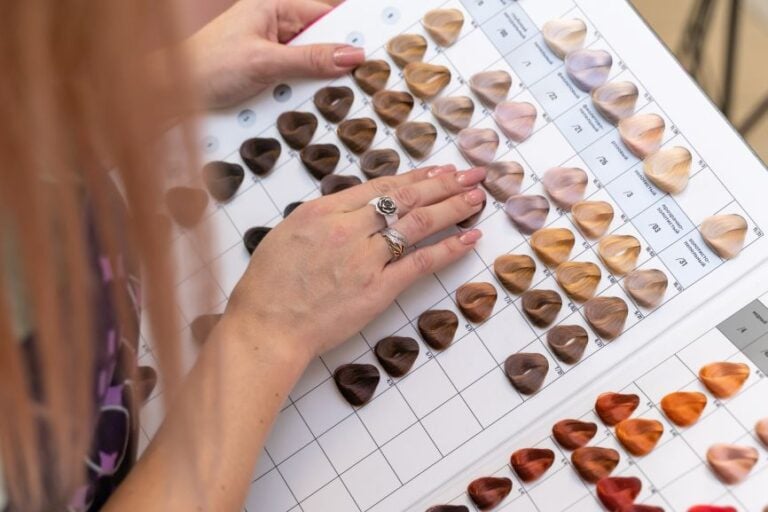
Duomo’s core colour line is designed as a versatile three-in-one system for permanent colour, demi-permanent colour and toning. Its collections include natural, ash, chocolate, gold, copper, red and pure-pigment families, giving colorists a structured palette for coverage and tonal control.
Resistant grey coverage
Ammonia-free professional colour can cover resistant grey effectively. The result, however, depends on more than the alkaline ingredient.
Reliable coverage generally requires:
- An appropriate natural or natural-natural anchor
- The developer specified for the service
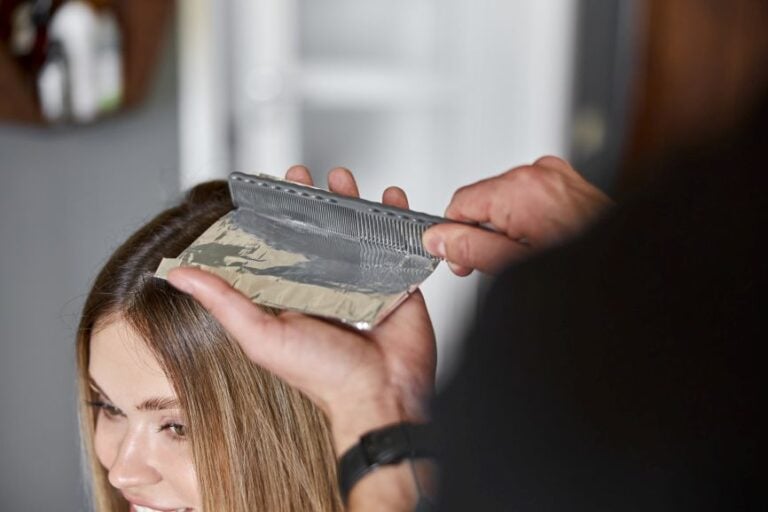
- Fine, controlled sectioning
- Complete saturation
- Strategic application to resistant areas
- The full recommended processing time
For many standard permanent grey-coverage services, 20-volume developer provides a practical balance between controlled access, oxidation and pigment deposit. Increasing the developer automatically is not a reliable fix for translucent temples or resistant hair. A stronger developer may expose additional warmth or reduce colour density without correcting poor saturation, insufficient anchor pigment or premature rinsing.
When coverage fails, assess the complete grey coverage formula framework before blaming the ammonia-free chemistry. Duomo’s guide to selecting developer volume for grey coverage also explains when 20 volume is appropriate and when another approach may be needed.
High-lift blonde services
High-lift work requires a separate conversation because substantial lift demands considerable alkalinity and oxidation.
A standard ammonia-free permanent shade should not be expected to replace a dedicated high-lift series or professional lightener. Attempting to produce several levels of lift with a formula that was primarily designed for deposit can lead to insufficient lightening, excessive warmth and weak tonal clarity.
Duomo’s core colour line is ammonia-free, but its Cavalla Highlift range is a separate low-ammonia system. Duomo states that Cavalla is designed to lighten and tone up to four levels, with optimum results on natural level 7 or lighter. This distinction should remain clear: the wider brand offers ammonia-free colour, but not every lightening product in the portfolio is ammonia-free.
Duomo also offers an ammonia-free five-level clay lightener. Product selection should therefore be based on the starting level, desired lift, placement method and manufacturer instructions, not on an assumption that one ammonia-free formula can perform every colour service.
How Ammonia-Free Formulas Affect Hair Integrity Across Multiple Services
Hair integrity is influenced by cumulative chemical exposure, not by one claim printed on a colour tube.
Every oxidative permanent-colour service changes the hair to some degree. Alkalinity swells the cuticle, while peroxide helps lighten natural pigment and develop oxidative colour molecules. Existing porosity, previous lightening, heat styling, environmental exposure and home care all affect how well the fibre tolerates that process.
Here’s the important correction: ammonia-free colour is not automatically less damaging than ammonia-based colour.
MEA is less volatile than ammonia, which helps reduce strong fumes. However, research comparing selected formulas has found that MEA-based colour can produce considerable protein loss and cuticle damage. One laboratory comparison found more damage in the tested MEA formulas than in its ammonia-based comparisons. That result does not prove that every MEA formula is more damaging. It shows why the entire formulation must be evaluated rather than assuming that “ammonia-free” always means structurally gentler.
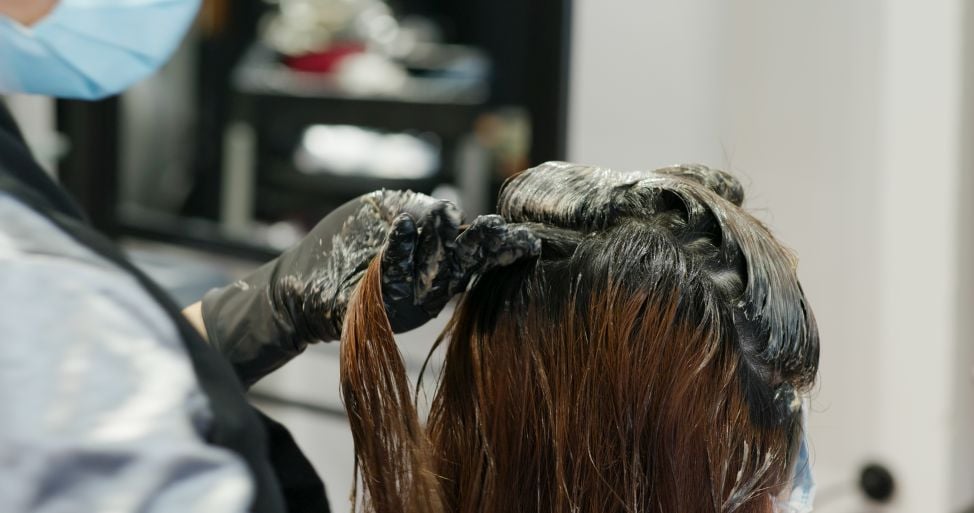
For a grey-coverage client returning every four to six weeks, protecting integrity depends heavily on application discipline:
- Apply permanent colour only to the regrowth when appropriate.
- Avoid dragging permanent colour through previously processed lengths.
- Use a deposit-focused formula to refresh faded mids and ends.
- Select the lowest developer volume that can achieve the objective.
- Respect the stated processing time.
- Reassess porosity and elasticity before each major service.
- Avoid repeated overlap around the hairline and parting.
These decisions often matter more than the absence of ammonia alone.
Duomo’s core colour line includes phytokeratin, aloe vera and rosehip flower extract. The brand positions these ingredients as supporting conditioning, moisture, shine and manageability during the colour experience. They may help improve the cosmetic feel of the hair, but they should not be described as cancelling oxidation, permanently repairing structural damage or making overlap harmless.
The long-term integrity argument for professional ammonia-free colour is therefore not that the formula cannot damage hair. It is that a thoughtfully designed system, paired with disciplined application, may help salons create a more comfortable and controlled maintenance programme.
Ammonia-Free Professional Color and Scalp Sensitivity: What Colorists Should Know
The most noticeable client-facing advantage of ammonia-free colour is often the lower-odour processing experience.
Because MEA is substantially less volatile than ammonia, an MEA-based formula generally releases fewer strong-smelling fumes into the salon. This can make regular root appointments more pleasant for clients who dislike conventional permanent-colour odour.
However, ammonia-free does not mean hypoallergenic.
Oxidative colour may still contain:
- Hydrogen peroxide
- Alternative alkaline agents
- Oxidative dye intermediates
- Preservatives
- Other ingredients capable of causing irritation or sensitisation
Research has identified both hydrogen peroxide and MEA as potential contributors to irritation associated with oxidative hair colour. A client can therefore react to an ammonia-free formula even if ammonia itself is absent.
Colorists should follow the product manufacturer’s allergy alert test instructions, avoid applying colour to an irritated or damaged scalp and stop the service if significant burning, swelling or other unexpected symptoms occur.
Duomo’s core colour is also marketed as PPD-free and fragrance-free. These characteristics may remove specific ingredients that some clients wish to avoid, but they do not make the formula reaction-proof. The FDA notes that sensitivities can develop after repeated exposure and recommends following the product directions and performing the specified skin test before every application.
What to Look for in an Ammonia-Free Professional Hair Color Brand
When comparing ammonia free professional hair color brands, look beyond the claim on the front of the packaging.
Identify the replacement alkaline system
Check the full ingredient list and technical literature. Determine whether the formula uses MEA, another amine or an alkaline salt.
The replacement affects odour, viscosity, processing and cleansing behaviour. No alkaline ingredient should be judged in isolation because concentration, pH, peroxide and the rest of the formulation influence the final effect.
Look for specific grey-coverage guidance
A professional brand should explain how its colour system handles resistant grey. Look for information on:
- Natural-base selection
- Developer volume
- Mixing ratios
- Processing time
- Resistant-zone application
- Refreshing previously coloured lengths
A broad claim of “complete coverage” is less useful than a repeatable technical framework.
Check for matched activators
Professional colour is normally developed and tested as a system. A matched activator helps maintain the intended consistency, peroxide concentration and application behaviour.
Using an unrelated developer may change viscosity, oxidation and coverage. It may also make troubleshooting more difficult because the result no longer reflects the manufacturer’s tested system.
Review the shade range and service categories
A complete salon line needs more than fashionable reflects. Look for dependable natural anchors, cool control, warm tonal families, creative shades and clearly separated lightening options.
Also check whether the brand distinguishes between permanent colour, demi-permanent colour, direct dyes, high-lift shades and lighteners. These categories use different chemistry and should not be treated as interchangeable.
Demand realistic ingredient transparency
Avoid vague descriptions such as “chemical-free” or “completely harmless.” Oxidative colouring is a chemical process.
A credible professional brand should provide ingredient information, service-specific instructions and realistic performance expectations. It should also acknowledge where formulation, developer choice and application technique affect the final result.
Salons interested in evaluating Duomo’s Italian-made colour collections and activator system can apply for a professional salon account.
FAQs About Ammonia-Free Professional Hair Color
Is ammonia-free professional hair color as effective as ammonia-based color for grey coverage?
Yes, a properly formulated ammonia-free permanent colour can provide effective grey coverage. Success depends on selecting an appropriate natural anchor, using the recommended developer, achieving complete saturation and allowing the full processing time. The ammonia-free label alone does not guarantee coverage.
What is used instead of ammonia in ammonia-free professional hair color?
Many ammonia-free oxidative formulas use monoethanolamine, also known as MEA or ethanolamine. Other formulas may use different amines or alkaline salts. The replacement still raises the pH and helps swell the cuticle so oxidative colouring can occur.
Does ammonia-free color still need a developer?
Permanent ammonia-free colour generally requires developer because hydrogen peroxide is needed to oxidise natural pigment and develop the dye precursors. Some oxidative demi-permanent colours also use a lower-strength activator. Direct dyes may not need developer, but that is due to their different colour technology.
Is ammonia-free hair color better for sensitive scalps?
It can provide a lower-odour experience and may feel more comfortable for some clients. However, alternative alkaline agents, peroxide and oxidative dyes can still cause irritation or allergic reactions. Ammonia-free should never be presented as hypoallergenic without specific substantiation.
Can ammonia-free professional color be used for high-lift blonde services?
Only when the specific product is designed for high-lift or lightening work. Standard permanent colour should not be assumed to provide several levels of lift. Always check the required starting level, maximum lift, developer and processing instructions for the selected product.
The Bottom Line
Ammonia-free professional colour replaces ammonia, but it does not remove alkalinity, oxidation or the need for controlled professional technique. Its most defensible advantages are a lower-odour salon experience and versatile performance when the complete formula has been engineered for the intended service.
Hair integrity depends on the full colour system and how it is used. The alkaline agent, peroxide strength, processing time, existing porosity and degree of overlap all influence the outcome.
For salons evaluating Italian ammonia-free colour as a possible line switch, the overview of Italian professional hair color brands explains the wider formulation considerations, and salons ready to evaluate Duomo can apply for a professional salon account directly.