Salon owners and lead colorists evaluating a new professional hair color line face a bigger decision than choosing a better-looking shade chart. Switching systems can affect grey coverage, formulation consistency, inventory costs, service timing and team confidence. Too many salons make the decision after a persuasive sales presentation or one successful model test instead of asking whether the line actually fits their clients, service menu and business model. The better approach is to evaluate every prospective line against the same practical criteria before committing.
Why Most Salon Color Line Switches Go Wrong, and How to Avoid It
Color line switches often go wrong because the decision is made too quickly.
A representative demonstrates an impressive formula. A stylist tries one shade and likes the result. Another salon owner recommends the brand. Suddenly, an opening order is being discussed before anyone has tested how the system performs across the salon’s real client base.
That is a risky way to make a business decision.
Switching professional hair color brands means changing more than tubes on the color bar. Your team may need to relearn shade numbering, mixing ratios, developer selection, processing times, grey formulas and correction strategies. Existing formulas may also need to be rebuilt rather than copied directly into the new system.
Before committing, evaluate six areas:
- Shade range and service coverage
- Grey coverage performance
- Formulation and ingredient transparency
- Education and technical support
- Professional distribution and exclusivity
- True cost per service
If you are comparing Italian professional hair color brands, use the same framework. Italian origin may be part of the brand story, but salon performance should make the final decision.
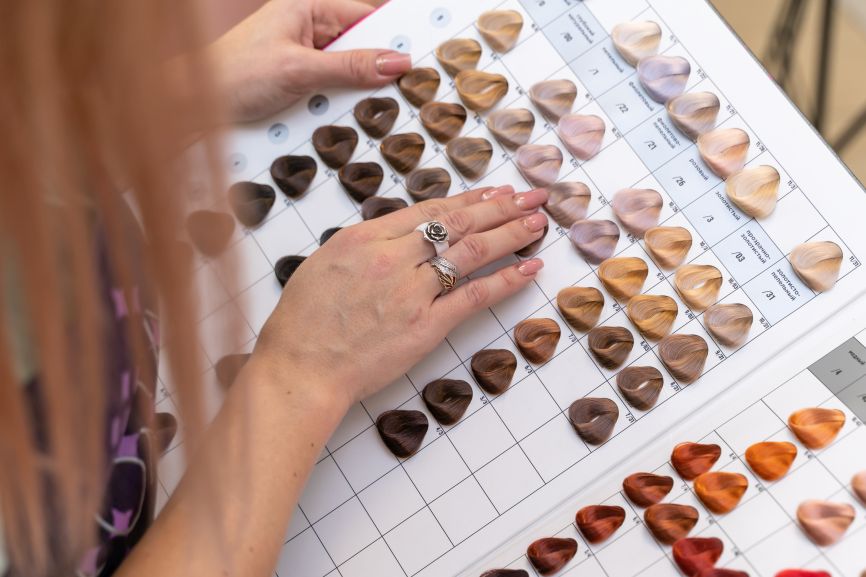
Criterion 1: Does the Shade Range Cover Your Full Service Menu?
Do not evaluate a professional shade range simply by counting tubes.
Evaluate it against your appointment book.
Look at several weeks of color appointments and identify what your team actually performs. Depending on your salon, a primary color system may need to support:
- Natural and neutral shades across the levels you use most
- Natural anchors suitable for grey coverage
- Brunette and chocolate tones
- Copper and red families
- Gold and warm blondes
- Ash, violet and other corrective tones
- Highlift options for appropriate virgin-hair lightening services
- Pure pigments or intensifiers for formula customization
- Direct or vivid shades if creative color is important to your menu
- Professional lighteners for services that require more lift than permanent color can provide
The important question is not, “How many shades does this company make?”
It is, “Can this brand’s overall system handle the services my salon sells?”
Gaps create operational problems. If you need one brand for routine color, another for resistant grey and a third for creative work, you may end up carrying additional developers, learning multiple technical systems and tying more cash up in inventory.
Before placing an opening order, pull 20 to 30 of your most frequently used formulas and determine whether you could realistically rebuild them using the prospective system.
Criterion 2: How Does It Perform on Grey Coverage Specifically?
Grey coverage deserves a dedicated trial because resistant white and grey hair can expose formulation and application weaknesses quickly.
A good result on an easy-to-color model tells you very little about how the system will behave on a client with resistant temples, a high percentage of grey or coarse regrowth.
Before switching, test the line on at least one client with genuinely resistant grey.
Evaluate:
- Coverage at the temples and front hairline
- Saturation and opacity
- Tone accuracy
- Whether the result appears too warm, cool or dense
- The recommended natural or neutral anchor
- Developer requirements
- Processing time
- Hair condition and cosmetic feel after rinsing
Do not judge the formula only when the client leaves the salon.
Review the result again during the client’s normal maintenance cycle. You want to see how the tone and coverage hold through repeated shampooing, styling and day-to-day wear.
Also evaluate the brand’s technical guidance. Does it explain how to formulate for different grey percentages? Does it provide recommendations for resistant zones, natural-base selection, developer choice, saturation and processing time?
A professional line should give your team a repeatable system rather than expecting them to solve every resistant-grey case through trial and error.
For a deeper technical breakdown, see Duomo’s guide to grey coverage performance.
Criterion 3: Is the Formulation Story Specific Enough to Matter?
Technical performance comes first, but formulation transparency matters too.
Clients may ask whether their color contains ammonia, whether products are vegan or cruelty-free, or what ingredients are being used during the service. Your team should be able to answer those questions accurately rather than relying on vague marketing language.
When evaluating a professional color line, ask:
- Is a complete ingredient list available?
- What alkaline system does the color use?
- If it is ammonia-free, what does that actually mean?
- Which conditioning ingredients are included?
- Are vegan and cruelty-free claims clearly stated?
- Does the manufacturer distinguish cosmetic conditioning benefits from claims about repairing structural damage?
Be cautious with broad terms such as “clean,” “natural,” “non-toxic” or “chemical-free.” Oxidative coloring is a chemical process, including when the formula is ammonia-free.
Ammonia-free also does not automatically mean damage-free, hypoallergenic or suitable for every sensitive client. The complete formulation, developer, processing time, previous chemical history and application technique all affect the service.
A useful formulation story is specific enough for a colorist to explain confidently and accurately during consultation.
If ammonia is part of your comparison, understanding what ammonia-free professional color actually means will help you evaluate competing systems more intelligently.
Criterion 4: What Does the Support and Education System Look Like?
Even a strong formula can produce inconsistent results when the team does not understand how to use it.
Changing lines means changing habits.
Ask exactly what educational resources are available before you buy:
- Are technical manuals or product knowledge resources available?
- Is online education provided?
- Are hands-on classes or educator-led sessions available?
- Is there guidance for converting familiar formulas?
- Are grey coverage protocols provided?
- Are mixing ratios and developer recommendations clearly documented?
- Can stylists get help with technical formulation questions?
- What support is available while the team is learning the system?
Do not settle for “we offer education.” Ask what that actually means.
This becomes particularly important in a multi-stylist salon. One senior colorist understanding the line is not enough if the rest of the team interprets the shade system differently.
The cost of poor education can appear later through wasted product, unnecessary corrections, longer appointments and inconsistent results.
Criterion 5: What Is the Professional Distribution Model?
Ask a simple question:
Who can buy the professional color?
Distribution matters because it affects how the product is positioned alongside the professional service.
Find out:
- Is a professional salon account required?
- What information is required to open an account?
- Can consumers buy the professional color directly?
- Is the line sold through mass-market retailers or major online marketplaces?
- Are professional and consumer products clearly separated?
- Is any geographic or territory protection offered?
Do not assume that professional exclusivity automatically means better technical performance. It does not.
But controlled professional distribution can support a salon’s value proposition by keeping formulation, developer selection and application within an appropriately trained professional environment.
The key is to understand the distribution model before you invest, rather than discovering later that the brand is positioned differently from what you expected.
Criterion 6: What Are the Real Costs, Including Yield and Waste?
Never compare professional color lines using tube price alone.
The number that matters is your real product cost per completed service.
Calculate:
Color cost: What does each tube cost and how much product does it contain?
Mixing ratio: How much finished formula does your standard mixture produce?
Developer cost: What matched activators are required and what do they cost?
Average usage: How many grams or ounces are typically required for a root retouch, all-over color or toner?
Processing time: Would the new system materially change appointment timing or chair capacity?
Inventory depth: How many shades and developers must you stock to cover your normal menu?
Dead stock: Which shades are likely to sit unused for months?
Opening investment: Is there a minimum order or required starter assortment?
Trial cost: Can you test a useful cross-section of the system before making a major inventory commitment?
A cheaper tube does not necessarily mean a cheaper service. If you need more product per application, additional activators or another line to fill important shade gaps, your total cost may rise.
Likewise, carrying dozens of rarely used shades can absorb cash without generating meaningful revenue.
Run the calculation against your own service mix rather than relying on a generic cost-per-tube comparison.
How to Run a Structured Trial Before Fully Committing
One successful model is not a proper color line trial.
Choose three to five clients who represent the work your salon regularly performs. Depending on your service menu, that might include:
- One resistant-grey client
- One brunette or dimensional-color client
- One highlift or blonde client
- One copper, red or other tonal client
- One vivid client if creative color is important to your business
For every service, follow the prospective brand’s technical instructions.
Do not immediately transfer habits from your current line. If the manufacturer specifies a particular mixing ratio, developer, natural-series proportion or processing time, use it. Otherwise, you are testing your modified version of the system rather than the system itself.
Record:
- Formula
- Starting level and hair history
- Mixing ratio
- Developer
- Processing time
- Amount of product used
- Ease of mixing and application
- Tonal accuracy
- Grey coverage where relevant
- Condition and feel after rinsing
- Total service time
Ask the client about the experience as well. Was the processing odor noticeable? How did the scalp feel? How did the hair feel immediately afterward?
Then assess the result again during the following weeks or at the client’s return appointment. Look for unwanted tone shift, excessive fading, changes in feel and overall client satisfaction.
Finally, compare those results with your current system.
A switching decision based on documented trials is far more useful than one based on the enthusiasm of a single demonstration.
Frequently Asked Questions
How long should a color line trial period last before making a full switch?
A useful trial should be long enough to evaluate both the immediate result and how the color wears between appointments. For many salons, following test clients through approximately one normal maintenance cycle provides more useful information than a same-day assessment. The goal is to observe coverage, fading, tone retention and client experience over time rather than meeting an arbitrary number of weeks.
Should I switch my entire salon at once or phase in a new color line gradually?
A phased transition can make the learning process and inventory changeover easier to manage. Start with carefully selected formulas or services, document the results and expand as the team becomes comfortable with the system. However, running two complete lines for an extended period can increase inventory costs and create unnecessary complexity.
What’s the biggest mistake salon owners make when switching color lines?
One of the biggest mistakes is evaluating the line too narrowly. A great result on one client cannot tell you how the system handles resistant grey, different tonal families, highlift work or the formulas your salon uses most frequently. Treat a switch as an operational and technical decision, not simply a product purchase.
How do I calculate the real cost of switching to a new professional color line?
Include the initial inventory, developers, accessories, education time and any temporary overlap with your existing system. Then calculate estimated product cost per service using the new line’s actual mixing ratio and your average application quantities. Also account for slow-moving inventory and any products you may not be able to use during the transition.
What should I ask a color brand representative before agreeing to a trial?
Ask about shade coverage, grey protocols, mixing ratios, developer options, processing times, ingredient documentation, education, technical support, distribution and opening-order requirements. Ask what products you need to test the services your salon actually performs rather than accepting a generic starter selection. The representative should be able to explain both how the system works and what is required to evaluate it properly.
Evaluate the Line Before You Commit to It
A new professional color line should earn its place in your salon.
The right system is the one that covers the services clients actually book, performs reliably across different hair types, provides clear technical guidance, makes financial sense and supports the experience you want your salon to deliver.
Duomo Pro’s core professional color is designed and created in Italy and is ammonia-free, fragrance-free, vegan and cruelty-free. Its color portfolio includes natural, ash, chocolate, gold, copper, red and pure-pigment families, alongside dedicated highlift, lightening and vivid options.
If Duomo is one of the lines you are evaluating, the next step is to apply for a professional salon account and assess the system against the same framework you would use for any serious color-line decision.