For professional colourists, achieving a clean, cool brunette can be challenging when orange and gold undertones continue showing through after colouring. Choosing the wrong neutralising reflect can leave the hair looking brassy, overly dark, or unexpectedly violet. The key is understanding which underlying pigments are present and selecting the right combination of cool tones. Duomo Pro’s Italian-made professional hair colour collections, including Modica Chocolate and Vesuvius Ash, give stylists options for creating rich, balanced brunettes with controlled warmth.
Why Violet-Based Brunettes Need More Than Violet to Cancel Orange
Blue neutralises orange, while violet neutralises yellow. When brunette hair contains both orange and gold undertones, a balanced blue-violet or ash-violet formula may be necessary to achieve a clean, cool result.
This distinction is essential because violet alone cannot reliably cancel strong orange pigmentation.
When natural brunette hair is lightened, its underlying warm pigments become visible. The dominant warmth depends on the level reached:
- Levels 4–5: Red-orange to orange undertones.
- Level 6: Orange-yellow undertones.
- Level 7: Yellow-orange undertones.
- Levels 8–10: Yellow to pale-yellow undertones.
These are general guidelines. Previous colouring, porosity, and the degree of lift can change the visible result.
For example, applying a violet-heavy formula to level 5 hair with strong orange warmth may leave some copper tones visible. The formula needs sufficient blue-based pigment to address the orange.
Violet becomes particularly useful when yellow or golden warmth is also present.
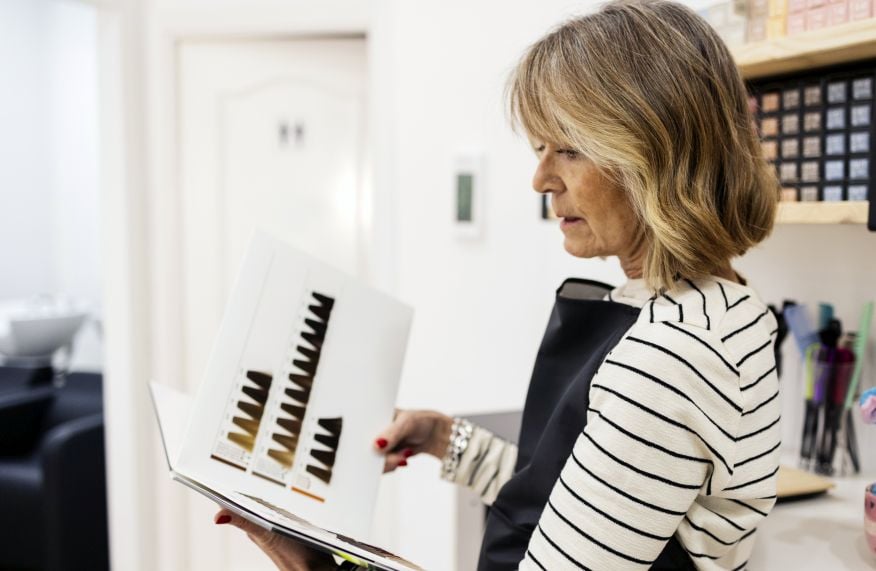
The correct approach is to identify the dominant pigment before choosing a shade. Duomo’s underlying pigment map provides a level-by-level reference for this assessment.
The goal is not to eliminate every trace of warmth. It is to create a balanced brunette that matches the client’s desired finish.
When to Use Violet vs Ash in a Brunette Formula
Choosing between violet, ash, and violet-ash depends on three factors: the starting level, dominant underlying pigment, and desired finish.
A client requesting a cool chocolate brunette may have orange warmth concentrated in the mid-lengths. Another may have golden highlights over a darker natural base.
Although both want cooler results, they may require different formulations.
Violet vs Ash Decision Chart
| Hair level | Underlying pigment | Recommended reflect | Formulation goal |
| 4–5 | Red-orange to orange | Blue-based ash, with additional correction where needed | Reduce copper warmth while maintaining depth |
| 5–6 | Orange to orange-yellow | Blue-violet or suitable ash-violet | Neutralise mixed orange and yellow warmth |
| 6–7 | Orange-yellow to yellow-orange | Ash-violet (VA) | Balance mixed warmth without excessive violet |
| 7–8 | Yellow-orange to yellow | Violet, with blue support if orange remains | Reduce gold and refine the cool finish |
| 4–5 deep chocolate | Red-orange or orange | Balanced cool-chocolate formula | Control unwanted warmth while preserving richness |
These are general formulation guidelines. The exact neutralising effect depends on the pigment composition of the chosen colour product.
Ash Brunette vs Violet Brunette: What’s the Difference?
An ash brunette is designed to create a muted, cool finish. Depending on the manufacturer’s colour system, ash shades may contain blue, green, violet, or combinations of cool pigments.
A violet brunette uses violet reflection to influence the finished tone, often creating a cool chocolate appearance when combined with the appropriate base pigments.
Neither is automatically better. A strong orange base generally needs blue-based correction, while yellow-gold warmth responds more directly to violet.
When both types of warmth are present, a balanced combination may produce the most natural result.
How to Use Duomo’s Modica Chocolate Series for Violet Brunettes
Duomo Pro’s Modica Chocolate collection provides violet-reflect options for stylists creating rich brunette shades.
The collection includes single-violet shades such as 4.2/4V, 5.2/5V, and 6.2/6V, alongside double-violet options including 4.22/4VV and 6.22/6VV.
These shade references are listed in Duomo’s official product collection.
What Does Double Violet (VV) Mean?
Within Duomo’s shade numbering, V identifies violet reflection, while VV identifies a double-violet shade designation.
Double-violet options provide a stronger violet direction than their corresponding single-violet shades, although their exact pigment concentrations should not be assumed from the naming alone.
This distinction matters when deciding how much violet influence the finished brunette needs.
A heavily violet-based result may be desirable for a cool chocolate finish, but excessive violet deposit can make lighter or highly porous sections appear purple or dull.
When Should You Use Double Violet?
Consider a VV shade when:
- The target brunette requires a pronounced violet-chocolate reflect.
- Yellow-gold warmth needs controlling.
- The starting hair has sufficient warmth to balance violet deposit.
- A strand test confirms that the selected shade produces the desired finish.
For predominantly orange undertones, evaluate whether additional blue-based correction is necessary rather than relying exclusively on VV.
How to Soften a Violet Brunette Formula
Blending a violet-reflect shade with a compatible natural shade can soften the violet appearance while maintaining brunette depth.
For example, a stylist working at level 6 might evaluate the compatibility of Duomo’s 6.22/6VV Modica Chocolate with 6.0/6N Milano Natural.
The appropriate proportions depend on the starting level, target shade, visible warmth, and manufacturer’s mixing instructions.
A fixed 50:50 ratio should not be treated as a universal brunette formula. Strand testing is particularly important when working on previously coloured or porous hair.
Remember that reducing the violet component also changes its neutralising contribution. If orange remains the dominant unwanted pigment, a different cool reflect may be needed.
The Vesuvius Ash Option: When Violet-Ash Reflects Make More Sense
Duomo’s Vesuvius Ash collection provides options for stylists seeking a muted, smoky, or cool brunette finish.
The collection includes violet-ash shades such as 4.21/4VA, 5.21/5VA, 6.21/6VA, and 7.21/7VA.
These shades are worth considering when the target requires both violet influence and an ash direction.
When Should You Choose Violet-Ash?
A violet-ash formula may be appropriate when:
- The hair contains mixed orange-yellow warmth.
- The client wants a cool brunette without a strongly violet appearance.
- Previously lightened sections require controlled neutralisation.
- The desired result is smoky or muted rather than a rich violet chocolate.
For example, level 6 hair with visible orange-yellow warmth may benefit from evaluating a suitable VA shade rather than automatically choosing an intense VV formula.
However, VA notation does not establish the exact ratio of blue to violet pigments. Colourists should consult Duomo’s technical guidance and shade swatches before selecting a formulation.
Transitioning From Warm to Cool Brunette
When a client wants to move from a warm brunette to a cooler result, first determine whether the existing colour is at the correct depth.
If the hair is already the desired level, a deposit-focused colour service may be sufficient.
If previous artificial colour is too dark, applying a lighter cool shade will not reliably lift that existing pigment.
Corrective colour removal or controlled lightening may be necessary before depositing the target tone.
Working at the correct starting level helps prevent a common mistake: attempting to solve an unwanted warmth problem by simply applying a darker ash shade.
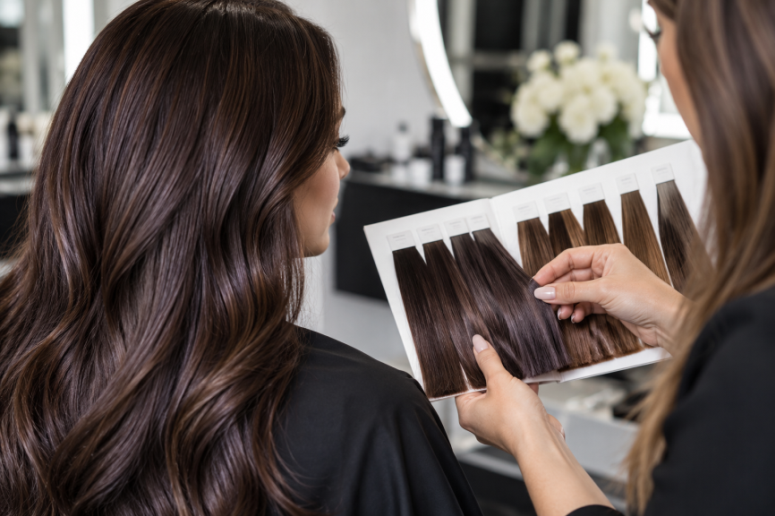
What to Watch for When Formulating Violet Brunettes
Correct reflect selection is only part of successful brunette formulation. Porosity, developer choice, processing, and previous colour history also influence the result.
1. Overusing Double Violet on Porous Hair
Highly porous hair may absorb or retain cool pigments unevenly, potentially creating purple, grey, or dull areas.
This is particularly important when the roots, mid-lengths, and ends have different chemical histories.
Before applying an intense violet formula, assess each section independently.
A strand test helps determine whether the violet component needs reducing or the application strategy needs adjusting.
2. Using the Wrong Processing Time
Processing time affects oxidative colour development and the finished result.
Leaving a violet formula on longer than instructed is not a reliable way to improve neutralisation. Equally, rinsing before the recommended development period may affect coverage, depth, or tonal results.
Always follow the processing instructions for the specific Duomo service.
Visually monitor the hair when appropriate, but do not substitute visual checks for manufacturer guidance.
3. Choosing an Inappropriate Developer
Developer strength influences lift, colour development, and the warmth exposed during processing.
Using more lift than necessary on natural brunette hair may reveal additional warm underlying pigment.
Previously coloured lengths generally require a different assessment from untreated roots.
A lower-volume, deposit-focused approach may be appropriate for some services, but developer strength and mixing ratios must follow the instructions for the selected Duomo product.
Do not automatically use 10-volume developer on every previously coloured length. The correct choice depends on the intended service and product requirements.
4. Ignoring Uneven Porosity
Hair with porous ends and more resistant roots may develop colour unevenly.
A single formula applied uniformly does not always create a uniform result.
Before colouring:
- Evaluate the condition of the roots, mid-lengths, and ends.
- Identify areas with previous lightening or colour buildup.
- Assess porosity and elasticity.
- Consider compatible porosity-management products where appropriate.
Porosity-balancing treatments may improve consistency, but they cannot guarantee identical pigment absorption across damaged and healthy sections.
5. Neutralising Too Much Warmth
A successful chocolate brunette does not necessarily need to be completely ash-toned.
Some controlled warmth gives brunette hair visual richness and depth.
Overloading the formula with cool pigments can create a flat, muddy, or overly dark appearance.
The objective is to neutralise unwanted brassiness while preserving the dimension that makes the brunette attractive.
For further guidance on recurring warmth, explore Duomo’s brassy brunette fix guide.
How to Maintain a Cool Violet-Based Brunette
Even carefully formulated cool brunettes can gradually reveal warmth as deposited colour fades.
The rate of fading depends on hair porosity, the colour service performed, washing frequency, heat styling, and environmental exposure.
To support colour longevity, recommend a suitable colour-care routine that includes gentle cleansing, conditioning, and protection from excessive heat.
Maintenance products should match the warmth that appears:
- Blue-pigmented products: May help reduce visible orange tones.
- Violet-pigmented products: More suitable for yellow or golden warmth.
- Colour-refreshing glosses: Can help restore the desired tone when professionally selected and applied.
Blue or violet shampoos are maintenance tools, not substitutes for correcting significant formulation or lightening problems.
Clients with highlights or highly porous sections should use colour-depositing products cautiously because pigment may accumulate unevenly.
A professional gloss or colour refresh can restore cool reflection when needed. The timing should reflect the client’s actual fading pattern rather than an arbitrary schedule.
FAQs About Violet-Based Brunette Hair Colour
What Is a Violet-Based Brunette Hair Colour?
A violet-based brunette is a brown hair colour containing violet reflection that influences the finished shade. Depending on the starting hair colour and formulation, it may produce a cool chocolate or subtly violet-toned brunette. Violet is particularly useful for controlling yellow warmth, while orange generally requires blue-based neutralisation.
Does Violet Hair Colour Cancel Orange Tones in Brunettes?
Violet does not directly neutralise strong orange tones. Blue is the complementary colour to orange, while violet neutralises yellow. For brunettes displaying both orange and yellow warmth, a suitable blue-violet or ash-violet formula may provide more balanced correction.
What’s the Difference Between Ash and Violet Brunette Formulas?
Ash brunette formulas aim to create a muted, cool finish, while violet brunette formulas emphasise violet reflection. The pigment composition of ash shades varies between manufacturers. Selecting the right formula requires assessing the dominant underlying warmth and the client’s desired result.
Will a Violet-Based Brunette Look Purple on My Client?
A violet-based brunette may develop a noticeable purple cast if too much violet pigment is deposited, particularly on lighter or highly porous hair. Selecting the correct level, controlling reflect intensity, and performing a strand test can reduce this risk. Compatible natural shades may help soften the violet appearance when used according to manufacturer guidance.
How Long Does a Violet Brunette Colour Last Before Going Warm?
Colour longevity depends on the formulation, hair condition, washing habits, and maintenance routine. As deposited cool pigments gradually fade, underlying warmth may become more noticeable. Some clients benefit from a professional gloss after several weeks, while others maintain their preferred tone for longer.
Create Cleaner, Cooler Brunettes With the Right Reflect
A successful violet-based brunette begins with identifying the underlying pigment rather than automatically choosing the strongest violet shade.
Duomo Pro’s Modica Chocolate and Vesuvius Ash collections provide professional colourists with different approaches to creating cool, dimensional brunettes. Modica Chocolate offers violet-reflect options, while Vesuvius Ash includes ash and violet-ash shades for more muted results.
Selecting the right formula requires evaluating the starting level, dominant warmth, existing artificial pigment, porosity, and desired finish.
For the full underlying pigment breakdown that determines which reflects to use at every level, the underlying pigment map is a foundational reference for brunette neutralisation work.